
Alaska Police Records
Alaska police records are public documents held by law enforcement agencies across the state's 30 boroughs and census areas. These records include incident reports, arrest logs, criminal history reports, dispatch data, and court case files. Most fall under the Alaska Public Records Act, which gives any person the right to inspect and request copies of records held by state and municipal agencies. This guide covers how to search Alaska police records online, which agencies handle requests in each borough and city, and what fees and timelines to expect.
Alaska Police Records at a Glance
Alaska Public Records Act
The Alaska Public Records Act (APRA) is the primary law that governs access to government records in Alaska. It sits at AS 40.25.100 through AS 40.25.295. Under the APRA, public records held by state agencies and municipal governments are open to inspection by any member of the public. You do not need to explain why you want the records. Citizenship and residency don't matter. The law presumes every record is public unless a specific legal exception authorizes withholding it.
The APRA defines public records broadly. Books, papers, files, accounts, writings, drafts, and electronic documents all fall within scope as long as they were developed or received by a public agency and preserved for informational or organizational purposes. For law enforcement, this includes incident reports, dispatch logs, arrest records, use-of-force reports, and other documents generated by police work. Records that would interfere with an active investigation, endanger safety, or reveal confidential sources may be withheld under AS 40.25.120, but these exemptions are specific. The default is disclosure.
Agencies must give an initial response within 10 working days. The clock starts on the first working day after the request arrives. If a full response isn't possible in that window, the agency must notify you in writing of the reason and a projected completion time. You can appeal a denial to the agency head within 60 working days of the denial notice. If that doesn't work, you can seek judicial review through the superior court under AS 40.25.125. Personnel costs may be charged if producing the records requires more than five staff hours in a calendar month.
The Alaska Public Records Act page at the Alaska Department of Law provides the full statutory text and guidance documents for filing records requests with any state or municipal agency.
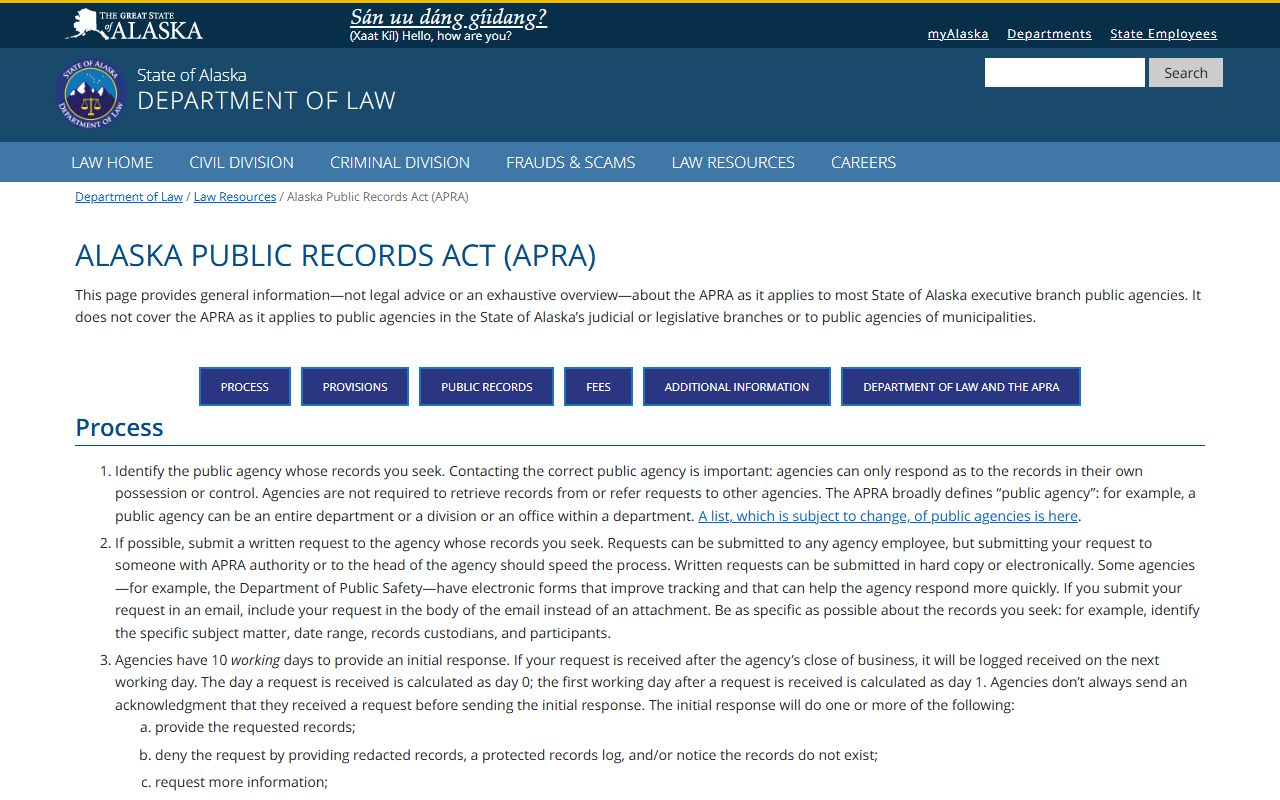
Use this resource to understand the scope of your rights, the specific exemptions that agencies may cite, and the appeal process if a request is denied.
Alaska Criminal History Background Checks
The Alaska Department of Public Safety administers the Criminal History Background Check program through the Criminal Records and Identification Bureau. Criminal history data is stored in the Alaska Public Safety Information Network, called APSIN. This repository holds adult criminal arrest and conviction records for individuals 18 and older. It covers misdemeanor and felony offenses. Infractions, traffic violations, and most juvenile criminal offenses are not included. The report will show convictions, dismissed charges, and not-guilty findings.
Requests can be made by name or by fingerprint. A name-based search costs $20 for the first copy and $5 for each additional copy. Fingerprint-based checks run $35, made payable to the State of Alaska. State laws AS 12.62.110 through AS 12.62.120, AS 12.62.160 through AS 12.62.170, AS 12.62.400, and AS 12.62.900 govern how criminal justice information is maintained and distributed. Federal laws including Pub. L. 92-544 and the FBI CJIS Security Policy also apply.
Walk-in service is available at DPS offices in Anchorage (907-269-5767), Fairbanks (907-451-5100), Juneau (907-465-4000), Kenai (907-262-4453), Ketchikan (907-225-5118), Kodiak (907-486-4121), Palmer (907-745-2131), and Sitka (907-747-3254). Some locations require appointments. Mail-in requests accept cash, check, or money order only. In-person requests require two forms of photo ID, one government-issued. The main contact for the Criminal Records Bureau is 5700 E Tudor Road, Anchorage, AK 99507, phone 907-269-5767, email dps.criminalrecords@alaska.gov.
Third-party requests require the record subject to sign a consent form and an Unsworn Falsification Statement authorizing release. The form must be complete. Incomplete forms or those without payment are returned to the requestor.
The Alaska Online Criminal History Report Portal lets individuals submit a name-based request for their own criminal history report using their social security number and Alaska driver's license or state ID.
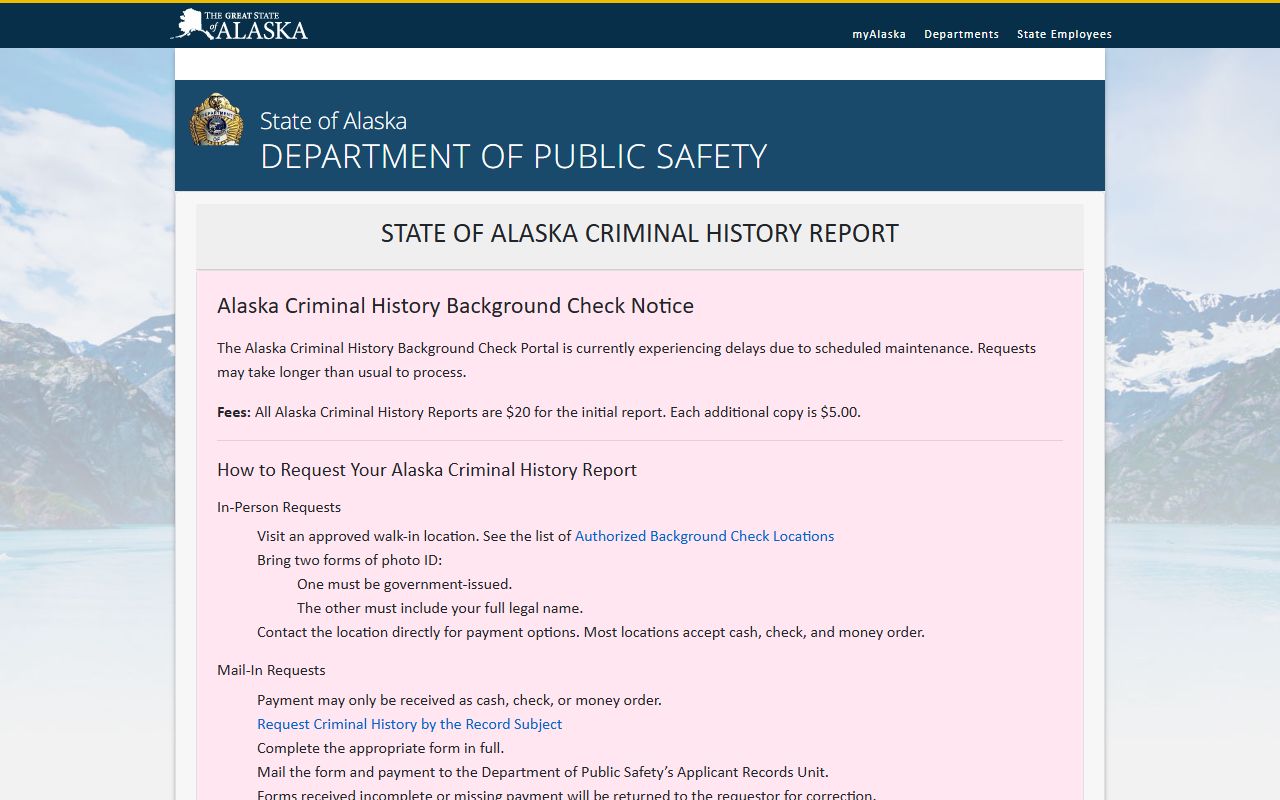
After entering your email, a secure link is sent to you. Click it to complete the form. This is the fastest way to get a copy of your own criminal history in Alaska without visiting an office.
Note: If you don't want to enter your SSN and ID number online, or if those documents aren't available, use the in-person or mail-in option at a DPS walk-in location instead.
Alaska CourtView Case Search and Court Records
The Alaska Court System provides free public access to court case records through CourtView. This statewide database covers trial and appellate court cases. You can search by party name, case number, or other identifiers. Results show case status, party names, docket entries, hearing dates, and judge assignments. CourtView is not a criminal history check. Some records don't appear on CourtView at all, including cases sealed by court order, foreign protective orders, and certain cases dismissed at the initial hearing.
Under AS 22.35.030, the court system may not publish a record online if 60 days have passed since an acquittal or dismissal and the defendant was acquitted of all charges or all charges were dismissed outside a plea agreement. Cases where a defendant completed a Suspended Imposition of Sentence and the conviction was set aside under AS 12.55.085 are also excluded from the public index per Alaska Rules of Court, Administrative Rule 40(a). Always confirm a date of birth before concluding a record belongs to the person you're looking for.
Alaska case numbers have four parts. The prefix shows the judicial district and court location. Next comes the two-digit filing year. Then comes the sequence number. Last is a category suffix, such as CI for civil or CR for criminal. For example, 3PA-98-01234CR means Third Judicial District, Palmer, filed in 1998, the 1,234th case, criminal category. Alaska has four judicial districts covering the entire state.
The CourtView public case search is the main portal for looking up court cases across all four of Alaska's judicial districts, covering criminal, civil, and traffic matters.
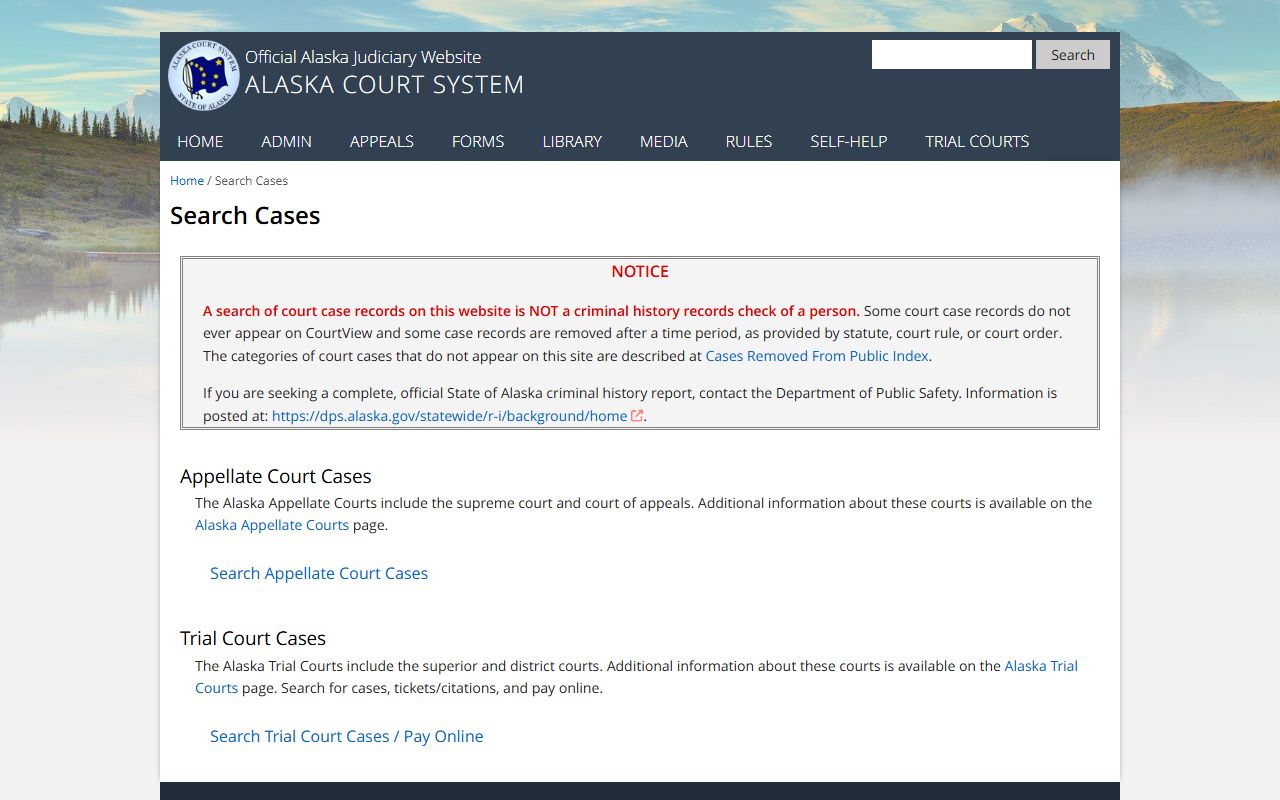
For cases not visible in CourtView, contact the clerk of the relevant trial court directly to ask about the case status or whether the file is sealed.
Requesting Copies of Alaska Court Records
Most Alaska court files are open for public inspection. Copies should be requested from the clerk of court where the case was filed. You can go in person, send a request by email, fax, or mail. The Alaska Court System uses location-specific forms. Anchorage, Saint Paul Island, and Sand Point use form TF-311 ANCH. Fairbanks uses TF-311 FBKS. Palmer uses TF-311 PA. All other locations use the standard TF-311 form. For audio recordings, parallel forms (TF-304 by location) apply, and CDs cost $20 each. Search warrant records require form CR-714.
Copy fees are set statewide. The first document costs $5. Each additional document requested at the same time is $3. Certified copies are $10 for the first and $3 for each additional copy of the same document requested at once. Exemplified or authenticated copies are $15 each. Research time runs $30 per hour. Online requests in Anchorage take 4 to 6 weeks to process. Palmer takes 2 to 4 weeks. Valdez is currently taking 4 to 6 weeks as well. In-person requests at most courts are handled the same day. Juvenile case files are confidential and available only to parties in the case.
The Alaska Trial Courts page lists each court location with mailing addresses, contact information, and specific request forms for obtaining copies of case files.
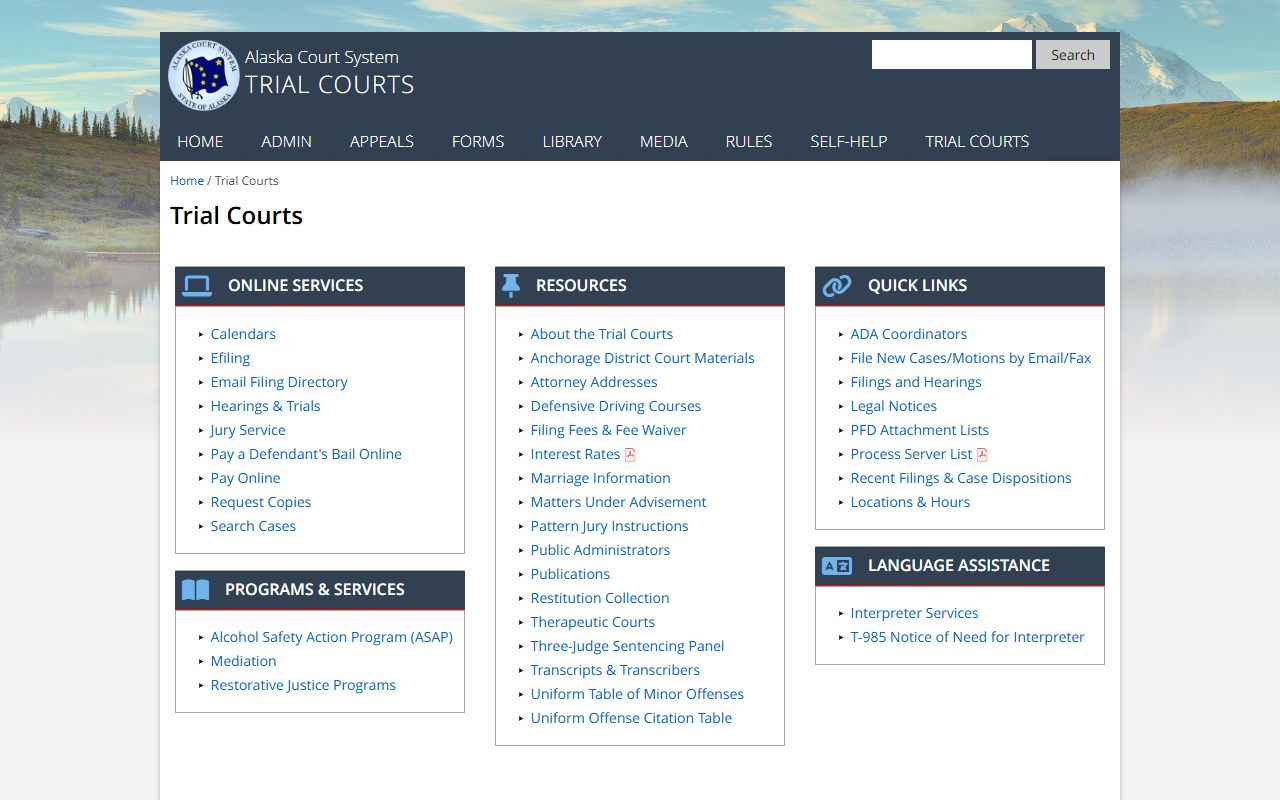
The trial courts include superior and district courts. For appellate court records including supreme court and court of appeals cases, see the Alaska Appellate Courts pages linked from the main court system website.
Alaska Daily Dispatch Reports
The Alaska Daily Dispatch is a public tool from the Department of Public Safety. It lets anyone search for state trooper dispatch reports by date range or incident number. No account or login is required. Enter a start date, end date, and optional text to narrow results, or enter a specific incident number if you have it. This is useful for checking whether a call was logged, confirming details of a known incident, or reviewing recent law enforcement activity in a specific area.
Daily dispatch data covers Alaska State Trooper activity statewide. It does not include incident records from city police departments, tribal police, or other local agencies. Those records must be requested directly from the relevant department.
The Alaska DPS Daily Dispatch portal provides searchable state trooper dispatch data for the entire state, accessible to the public without registration or fees.
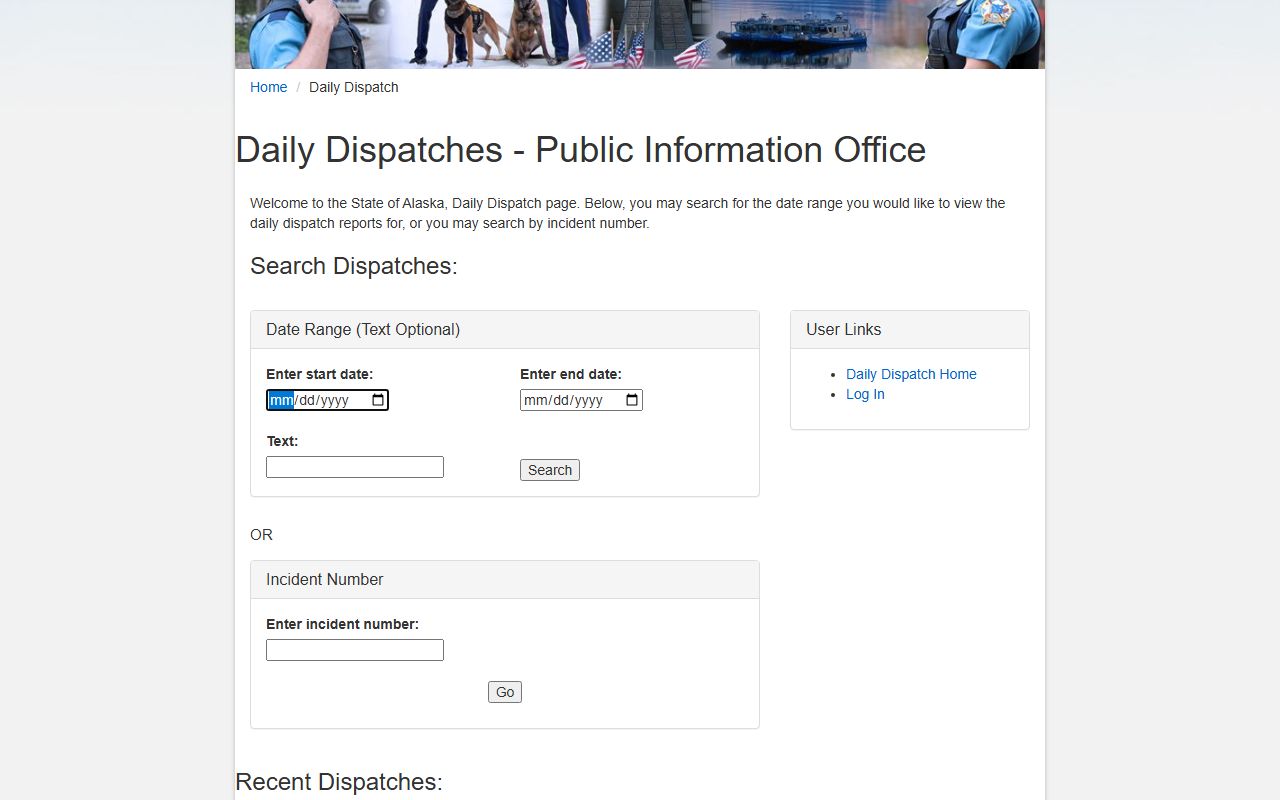
Searches can be filtered by date range and by text to locate incidents from a specific post, location, or type of call.
Alaska Sex Offender and Child Kidnapper Registry
The Alaska Sex Offender and Child Kidnapper Registry is a free public database run by the Division of Statewide Services under DPS. It currently holds over 3,640 entries. You can search by name, address, zip code, city, or registration status, or browse the full list. There is no charge. The registry includes both registered offenders and those who are required to register but may not be in compliance.
Registration is governed by AS 12.63.100. Anyone convicted of a qualifying sex offense must register by the next working day after conviction if not incarcerated, or within 30 days before release from a correctional facility. People relocating to Alaska from another state must register by the next working day of arriving. Duration of registration depends on the offense. A single non-aggravated offense requires 15 years of registration after unconditional discharge with annual verification. An aggravated offense, or two or more non-aggravated offenses, requires lifetime registration with quarterly verification.
House Bill 66, enacted July 2024, added new requirements under this statute. Registrants must now report passport numbers, professional licensing information, and temporary lodging of seven or more days. Anyone planning international travel must provide 21 days of written advance notice to DPS. Address changes and changes to email or online messaging accounts must be reported by the next working day after the change. Violations of these requirements carry criminal penalties. Contact the registry at (907) 269-0396 or 1-800-658-8892 from outside Anchorage.
The Alaska Sex Offender Registry provides searchable public access to registration data statewide, organized by name, location, registration status, and other search criteria.
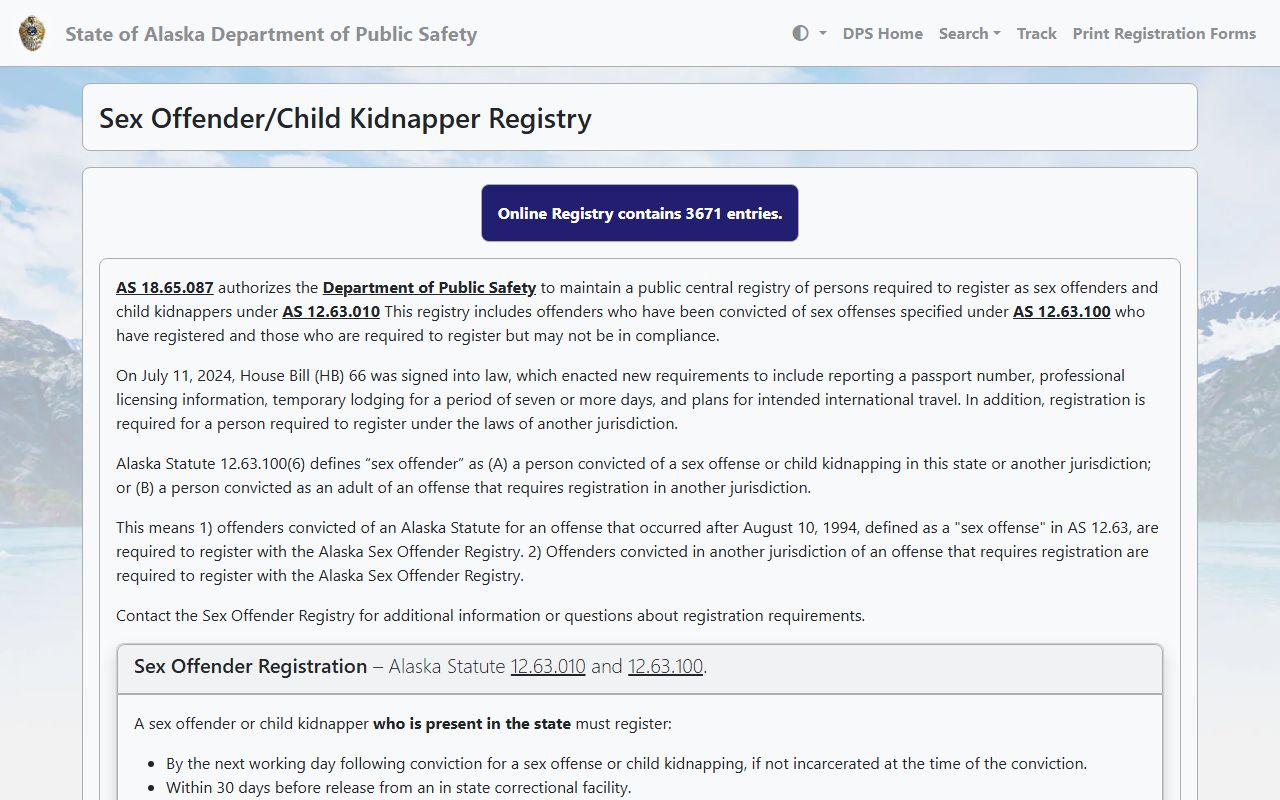
Note: The Alaska Supreme Court ruled in 2008 that registration requirements apply only to persons who committed their crimes after August 10, 1994, per the Alaska Sex Offender Registration Act.
Alaska State Troopers
The Alaska State Troopers provide law enforcement coverage across much of the state, especially in rural areas and unincorporated boroughs that don't have their own police departments. The Troopers are organized into five detachments. Detachment A covers Southeast Alaska including Ketchikan, Juneau, Sitka, and Wrangell. Detachment B serves the Mat-Su Valley, Copper Valley, and Valdez. Detachment C covers the Anchorage area. Detachment D handles Interior and Western Alaska including Fairbanks. Detachment E covers the Kenai Peninsula.
DPS headquarters sits at 5700 E Tudor Road, Anchorage, AK 99507. The general DPS number is (907) 269-5511. Regional dispatch numbers: Mat-Su Valley and Copper Valley at (907) 352-5401, Kenai Peninsula and Southeast Alaska at (907) 262-4453, Interior and Western Alaska at (907) 451-5100. Trooper posts are located in communities statewide including Bethel, Cordova, Delta Junction, Dillingham, Dutch Harbor, Fairbanks, Glennallen, Haines, Hoonah, Juneau, Ketchikan, Kodiak, Kotzebue, Nome, Palmer, Sitka, Soldotna, Tok, Valdez, Wrangell, and Yakutat. For wildlife enforcement, the Alaska Wildlife Troopers handle fish and wildlife violations, boating safety, and resource protection through the same regional dispatch network. Report wildlife violations at 1-800-478-3377 or through the AK Tips app.
Alaska Department of Corrections Records
The Alaska Department of Corrections (DOC) manages incarcerated individuals in facilities across the state and maintains records on offenders. The Research and Records department handles public records requests. Mailing address: P.O. Box 112000, Juneau, Alaska 99811-2000. Records phone: (907) 465-3485.
DOC Offender Profiles from 2002 through 2021 are available online at doc.alaska.gov. The 2022 offender profile and 2025 Trends, Counts, and Percentages reports are also posted there. Population statistics cover incarcerated individuals by institution, gender, legal status (sentenced, unsentenced, federal, Title 47), race, and age. DOC facilities include Goose Bay Correctional Center, Hiland Mountain Correctional Center, Lemon Creek Correctional Center in Juneau, Palmer Correctional Center, Spring Creek Correctional Center, and Wildwood Correctional Complex. Victim notification is available through the VINE link system. The DOC also provides public information about inmate visiting rules, mail policies, and account procedures for each facility.
How to Request Alaska Police Records
The agency you contact depends on which agency created the record. For state criminal history reports, use the DPS portal or visit a walk-in office. For court records, contact the clerk of the relevant court or search CourtView. For incident reports created by a city police department, contact that department's records unit. For reports filed by Alaska State Troopers, contact the post where the incident was handled. Many agencies now offer online request portals, but some still require a paper form submitted in person or by mail.
When submitting a records request, be as specific as you can. Include the incident date, the location, the names of people involved, and the case or incident number if you have it. Vague requests slow things down. Under the APRA, an agency has 10 working days to give you an initial response. If they need more time, they must tell you why and when they expect to respond. Requests denied in whole or in part must come with a written explanation identifying the specific legal exemption used to withhold the records.
Major city police departments all handle records differently. Anchorage Police Department uses an online records center. Juneau Police Department requires a written form submitted to the Records Unit. The Fairbanks Police Department uses a NextRequest portal at cityoffairbanksak.nextrequest.com. Ketchikan PD accepts faxed, mailed, or in-person requests. Wasilla PD uses an online portal or a PDF form. Palmer PD requires written requests using their specific form. Fees vary by agency and by the type of media requested.
Note: Records tied to open investigations or pending criminal charges may be withheld under AS 40.25.120(a)(6) until the case is resolved or the District Attorney issues notice of adjudication.
Alaska Missing Persons Clearinghouse
The Alaska Missing Persons Information Clearinghouse is run by the Department of Public Safety under AS 18.65.620. Reports must go to local law enforcement in the jurisdiction where the person went missing. There is no 24-hour waiting period. Only a law enforcement officer can take the report. DPS works to enter all missing persons into the national NamUS database within 30 days. For cases not resolved within 48 hours, the Clearinghouse must receive the report. In August 2023, DPS and the Anchorage Police Department released a first-of-its-kind Missing Indigenous Persons Report covering all Alaska Native and American Indian missing persons in APSIN. Contact the Clearinghouse at (907) 269-5497 or 1-800-478-9333. Email investigative information to dps.missing.persons@alaska.gov.
Browse Alaska Police Records by Borough
Each of Alaska's 30 boroughs and census areas handles police records differently. Select a borough below to find local law enforcement contact information, records request procedures, and direct links to official resources.
Police Records in Major Alaska Cities
City police departments each run their own records process. Pick a city below to find the department's contact details, forms, fees, and instructions for requesting police reports in that community.